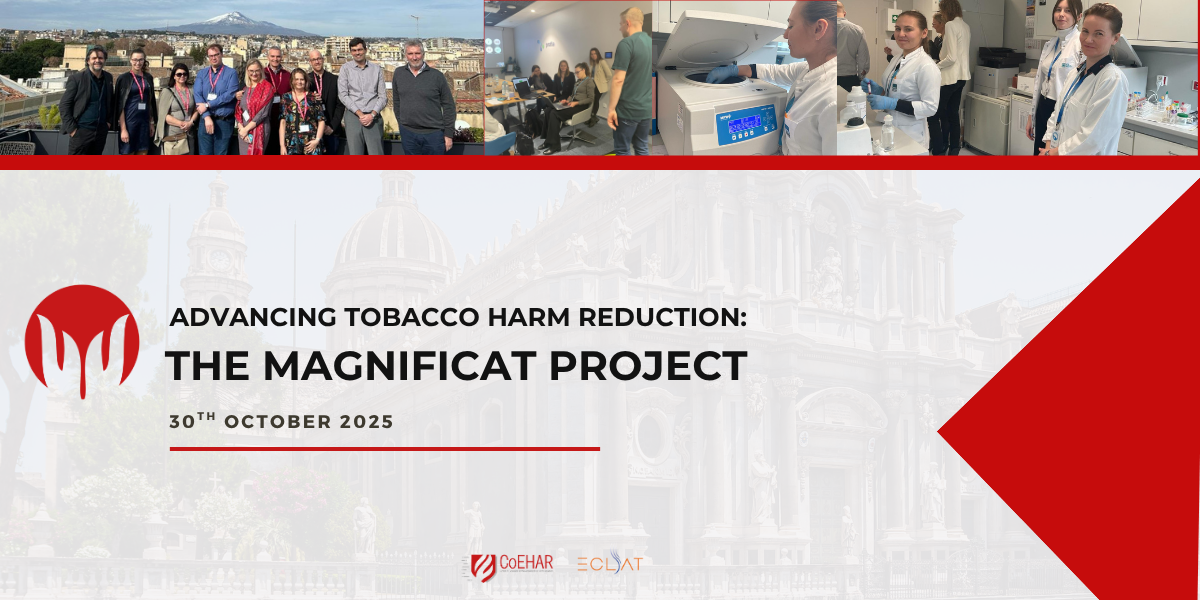
On Thursday, October 30, CoEHAR hosted the final event of the MAGNIFICAT project— a study that, for the first time, carefully analyzed the switching process of dual users through an innovative methodology and the analysis of biomarkers of exposure and harm
“The MAGNIFICAT project has the potential to really advance our understanding of dual use and hopefully resolve some of the inconsistencies in the current research,” said Arielle Selya, Senior Scientist at Penny Associates, opening the streaming event dedicated to the MAGNIFICAT study — the first longitudinal study to evaluate and measure changes in risk and health factors among a group of dual users.
In recent years, evidence supporting harm reduction among individuals who switch exclusively to combustion-free products has grown, as has general trust in harm reduction principles. However, dual use — the combined use of conventional cigarettes and new-generation products — still raises serious concerns and is often associated with an increased risk compared to exclusive use.
Moreover, international studies continue to produce divergent findings, some suggesting that dual use may even hinder cessation. This situation is mainly due to discrepancies in the scientific literature, which can be addressed through methodologically robust studies.
This was precisely the focus of the international research team behind the MAGNIFICAT project, which not only analyzed specific biomarkers of exposure and harm but also divided dual users into subgroups and employed a research protocol designed to minimize the flaws observed in previous studies.

“We involved 300 smokers, divided into two study groups,” explains Marta Zakrzewska, Site Manager of Clinical Research at MTZ Clinical Research, powered by PRATIA. “The first was the interventional group: smokers who were willing to reduce their cigarette consumption by using e-cigarettes; the second, the control group, continued to smoke conventional cigarettes.”
The first innovation of the research protocol lay in the recruitment process: in addition to traditional methods, social media and word of mouth were used — the latter alone accounting for over 55% of participants. The goal was to obtain a sample as diverse as possible in terms of age, gender, and product-use patterns.
The main objective was to identify subjects with low, moderate, and intensive daily cigarette (CPD) reduction, based on a careful assessment of their smoking history.

“The minimum smoking history was 1.2 years among the lightest smokers, while some participants had an extensive smoking history, with the longest reaching 54 years.” adds Simona Veigl, from ABF.
“Another inclusion criterion was the number of cigarettes smoked per day (15 per day). Some participants smoked up to 35 cigarettes a day, with a large portion averaging around 20. How did we track their habits? Through data collected during visits and via the E-diary app installed on participants’ phones, where they answered daily questions.”
Using a specific formula that considered both baseline and ongoing cigarette consumption, researchers calculated the relative combustible cigarette-per-day reduction.
“With less than 1% reduction, the subject was still classified as a smoker; with over 99%, as a quitter. A clear and strong correlation was found between reduced combustible cigarette use and increased e-cigarette consumption.”
All these data were then integrated with the analysis of thirty biomarkers of exposure and six of potential harm.

“We analyzed biomarkers of exposure primarily in urine samples, including nicotine and its metabolites, along with tobacco-specific analytes such as tobacco-specific nitrosamines, aromatic amines, and polycyclic aromatic hydrocarbons.
We introduced propylene glycol as a specific biomarker for vaping. A few biomarkers of potential harm, like inflammation markers, were also included. The non-targeted analysis was added to gain a broader picture of the absolute exposure of dual users. Analyses were performed across three matrices: exhaled breath, urine, and blood samples,” explained Max Scherer, Medicinal Chemist at ABF in Germany.
The data showed that e-cigarette vaping did not significantly contribute to exposure to tobacco-related toxicants (beyond the expected increase in e-cigarette–specific markers like propylene glycol) and did not lead to an increase in glycidol exposure. The findings strongly indicate that combustible cigarettes remain the primary source of toxicant exposure among dual users.
“The MAGNIFICAT project is unique: it is the first study to analytically map how exposure to toxic substances changes between someone who smokes 1–2 cigarettes a day and someone who smokes 20.
To achieve this, we relied on an outstanding team of researchers and a rigorous methodological framework, with the ultimate goal of precisely and thoroughly studying the health impact on dual users. The results are clear: health outcomes depend on the degree of cigarette reduction, regardless of the ‘dual user’ label. The combustion biomarkers measured in the blood and urine of dual users decrease progressively as the number of cigarettes smoked decreases. In short: fewer cigarettes, less smoke, and therefore less harm.
Once again, CoEHAR’s research has proven to be pioneering, informative, and innovative. Of course, the ultimate goal for dual users remains complete smoking cessation. However, MAGNIFICAT demonstrates that even dual use—when accompanied by a drastic reduction in the number of traditional cigarettes—leads to measurable health benefits“, concluded Prof. Riccardo Polosa, CoEHAR Founder.
The results present a compelling case for tobacco harm reduction strategies, adding valuable nuance to the understanding of dual-use patterns and their health implications.